Nicolaas Cornelis Helleman
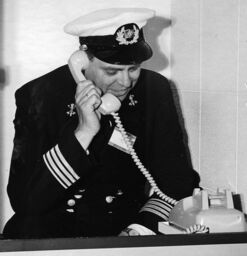
| Family Name | : Helleman |
| Given Names | : Nicolaas Cornelis |
| Date of Birth | : 1912-10-07 |
| Place of Birth | : Oude Niedorp, Noord-Holland |
| Profession | : Scheepswerktuigkundige (Chief Engineer) |
| Date of Death | : 1976-11-18 |
| Final Place | : Gouda, Zuid-Holland |
![[ Certificat 40-45 ]](/avg/pic/Certificaat_40-45.png) Nicolaas Cornelis Helleman served in the Dutch merchant fleet, placed under British command, during the war years.
He entered the war as a 4th engineer for the KNSM. Having served, on various ships, in the
Atlantic, Mediterranean, and Pacific theaters, he exited the war as 3rd engineer.
Nicolaas Cornelis Helleman served in the Dutch merchant fleet, placed under British command, during the war years.
He entered the war as a 4th engineer for the KNSM. Having served, on various ships, in the
Atlantic, Mediterranean, and Pacific theaters, he exited the war as 3rd engineer.
Two of the ships he served on, the S.S. Breda and S.S. Alpherat were sunk, while he was aboard. At the first sinking all personal posessions were lost. Having learned from that, he subsequently helt a small suitcase at the ready, to grab, should a sinking happen again. Being that the ship's engineers work "down below" escaping a sinking ship wasn't always a given.
Life lesson learned and passed along:
"Always one hand for the ship, and one hand for yourself."
![[ S.S. Breda ]](/avg/pic/SSBreda.jpg)
After the invasion of the Netherlands in May 1940 the Breda fled to Britain, where she was placed under the control of the P&O Line, and armed with a single 4.7-inch (120 mm) gun. On 23 December 1940 she was laying off Oban, Scotland, as part of a convoy being assembled that was bound for Bombay. She carried a mixed general cargo that included 3,000 tons of cement, 175 tons of tobacco and cigarettes, three Hawker and 30 de Havilland Tiger Moth biplanes, Army lorries, NAAFI crockery, copper ingots, rubber-soled sandals, banknote paper, 10 horses, and nine dogs.
At dusk a group of Heinkel He 111 bombers flying from Stavanger, Norway, swept across the anchorage,
and straddled the Breda with four 250 kg (550 lb) bombs. The force of the explosions ruptured a water
inlet pipe, and the engine room was rapidly flooded, depriving the ship of power. She was quickly taken under tow,
and beached in shallow water in Ardmucknish Bay. The next day, only a small part of her cargo had been offloaded
before a storm swept her into deeper water where she sank to a mean depth of 26 metre (85ft)
at position 56°28′32″N 5°25′04″W.
![[ S.S. Alpherat ]](/avg/pic/Alpherat.jpg)
The S.S. Alpherat departed Durban, South Africa on November 17, 1943 at 11pm bound for the United Kingdom, sailing via the Suez Canal. The ship was loaded with some 7,091 tons of general cargo, including copper, copper ore, platinum, tobacco, tea, as well as brown sugar.
Then early on December 21, The Convoy Commodore signalled that an air-attack was to be expected.
Immediately all guns were manned by the British gunners and soon enough, fire was opened.
Then, at 4.55 pm the Alpherat was hit by a bomb near and slightly forward of the starboard
bridge, and an explosion happened in hold #2 with water entering the hold at a high rate.
The watertight doors were rapidly closed, but it seemed that water was also pouring into hold #1.
It was decided that all 23 passengers on board had to prepare to leave the ship. Although
pumping out the water in holds 1 and 2, the water level continued to rise. For the time being,
however, the ship managed to hold position in the convoy.
Then at 5.25 pm it became abundantly clear the ship could not be kept afloat much longer and Captain van Os reduced the speed until the ship came to a halt. Then her 23 passengers and all her crew of 65 left the ship and waited at a safe distance until they were picked up by one of the escort vessels, but they remained near the sinking ship for they were well aware that the ship could brake in two and sink, which she did at 7.10 pm. The Alpherat sank 150 miles east of Malta, at position 35º20' N, and 14º04' E. Thankfully all her passengers and crew were taken back to the UK in complete safety by one, or more escort vessels in good comfort!
Eye witness account of Margaret Watson (age 21):
Well we went into tea at about 4:30 as usual and at about 4:40 just
as we were going on deck the alarm sounded and a few seconds later the bomb fell.
I can’t remember hearing the plane. When it hit us I was just going to get my lifejacket,
I saw the splash of a near miss right alongside us and felt the ship shudder and heave.
The impact of the bomb was not nearly as great as one would have expected and for some
time afterward we didn’t know we had been hit. We thought it was the near misses.
We got together a few things and sat in the dining room as we had been told to do,
for about 40 minutes, waiting for the all clear. At first there was an awful noise
when our guns replied but after that all was quiet until rather unexpectedly one of
the officers came down and told us to abandon ship. Certainly a surprise.
The attack started at dusk, just the time they like best as the darkness covers them
when they are finished. After we had been hit we heard the pumps but at the time
didn’t know the reason for them. We thought it was because of fire. We heard the
rockets go off, but again we didn’t guess the reason. So when we were told to leave
the ship we didn’t have time to get as many things as we might otherwise have done.
Well, anyway, we dashed back and grabbed a few more things and went to the boats.
We got in without very much trouble, by then it was quite dark. The lowering of the
boats wasn’t much fun, but it was done without mishap. Waiting for the others to get
in after we were in the water, wasn’t too pleasant either, as several times we were
nearly smashed against the side. It was all due to Dad’s friend Mae that we got
away safely as he managed to get an oar, which he broke several times against the
sides, thus saving us.
We were in the Captain’s boat, the first to get away, the Captain never gave
a single order. In fact one would not have known that he was there. The 4th
officer had to take charge. He was very good, the only one to row, he got us away
from the ship, he gave all the orders, and he had to start the engine because the
Chief Engineer, who was also with us, was too terrified to move. He couldn’t even
answer when spoken to. I sat next to him. The 4th did a very good job of work and
so did Mae.
Another thing, the children were grand. They spent their time singing
‘Roll out the Barrel’, etc. I spent most of the time being and afterwards feeling
very sick and also, though it was very cold, I with three coats plus other things,
felt rather hot and was quite glad when it rained. It cooled us off and it wasn’t
long after that that we were picked up.
We were about 2 hours in the boats.
By the way, here I will say that of a large convoy we were the only ship to be hit
and it was a very lucky hit for us. Another few yards and we would all have been
goners. As it was, everyone was saved and no one injured – a lucky thing. It caught
us on the foredeck, went through two hold and exploded down in the cargo, sugar,
which muffled it quite a lot, but all the same it was enough to break her back.
Also the near miss parted the plates in her side, but even so she sank very slowly
at first. It was not till we were in the water that we saw how far down she was in
the front.
Another thing, the planes attacked us just ten minutes after our own
fighters had left us. Also we heard later that one of them had been shot down.
I hope it was the one that got us.
Well, to continue I must say that all the passengers were wonderful, also a few
English lads among the crew were very good. The Dutch wireless operator even refused
to stay and send out an S.O.S. One of the English lads pushed him out of the way
and did the job for him.
After about two hours one of the escorts came to our assistance. From the boats
she (HMS Saxifrage), a corvette, looked enormous, almost a Battle Ship. At first
I honestly didn’t see how we should ever get on board her, though we were very glad
to see her. Actually I managed it quite easily, I stood up and when a big wave
lifted the boat the sailors just hauled me over the side. Others had to climb up
a slippery ladder. Once again the boat got smashed until she was secured. It was
another call of ‘Thank God for the Royal Navy’ and they were British.
Well after
all that everything went much more smoothly and they gave us a great welcome.
They were very good to us, gave us hot tea, soup and cigarettes everything we
wanted in fact and later on beds. I am afraid I couldn’t make much use of anything
but a bucket, boy was I sick. We hung around the ship for a while to see if she
could be saved but shortly afterwards at 7:15 she went down, breaking in two.
That night 5 of us slept in the Captain’s cabin. We really were lucky to be picked
up so soon and to get away with everything so easily. I even managed to sleep part
of the night. The next day I lay down most of the time and was still very sea sick.
We were told that we would be taken to a certain port that day but later we were
told we would be transferred to another ship, the leading escort ship, a sloop,
a bigger and better ship (HMS Stork). At first we all hated the idea, there was
still a high sea running but better than the previous night. The worst thing was
the prospect of another trip in a lifeboat, but it was done on the leeward side of
the ships and everything went very well, only a short run and an easy ladder to
climb up and dozens of smiling, welcoming faces to greet one. Only the passengers
were transferred, the crew remained on the other ship.
I won’t mention the names
of either ship but when we got to ‘Our Ship’ as I will call her, we all realised
what a good thing the change had been, in size and comfort she couldn’t compare
with the other ship. She had been mentioned several times in the news and has 8
certain subs to her credit – a good record. The night before we were sunk her
commander (DSO) heard he had won the D.S.O. for the last sub and others of her crew
were decorated as well.
When we came on board we were taken straight to the ward
room where a lovely tea was waiting for us, I almost managed to have some.
We couldn’t have found a better ship anywhere, the officers and men were simply grand.